
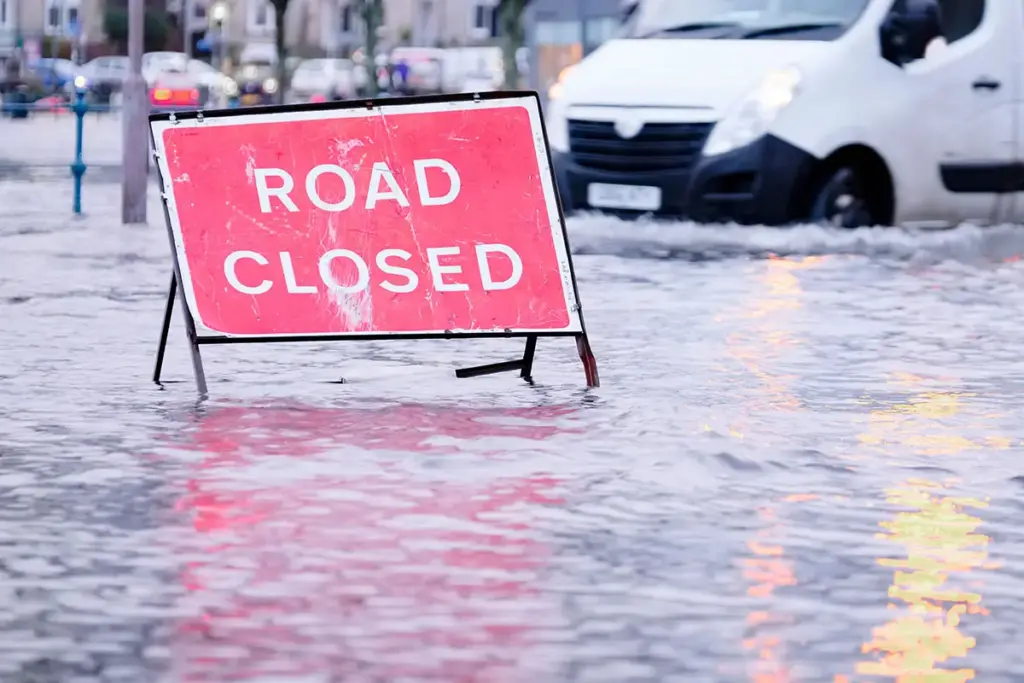

With hotter summers and wetter weather all year round, evidence of climate change lies no further than just outside the front door.
For this Perspectives article, Mitie’s Director of Sustainability Services, Vicki Lintern, reflects on UK organisations’ readiness for climate disruption.
While many are underprepared, Vicki argues the business case for investing in resilience is clear – and now is the time to put things right.
Living on a farm in Cornwall gave me a ringside seat for Covid 19’s impact on farming and the wider community. As the epidemic progressed, farmers were still producing food, but the infrastructure to get that food to consumers was disrupted due to the closure of restaurants and other outlets.
We tried to build local supply chains to make sure quality produce didn’t go to waste. This included me joining a fantastic organisation spun up in a very short amount of time called Farms to Feed Us. Its purpose was to raise awareness and connect the dots between producers and consumers. For the most part this worked, with farmers selling direct. Then everything returned to normal again and the local networks became less needed.
Looking back, you can almost excuse the supply chain breakdown because Covid was so unexpected. Noone knew it was going to happen, and when it did, it was very sudden. The same cannot be said for climate change. We’ve got the science. We’ve got the numbers. It’s happening and it’s happening now. Yet many organisations remain unprepared or even unaware of the extent to which they’ll be disrupted. In my opinion there is no excuse.
Fundamental impact of extreme heat
Summer 2026 has brought some remarkably hot weather. This began in May, when temperatures soared to 35.1 °C – the country’s highest ever recorded for the month. Hotter, drier summers are increasingly common here, and yet across southern England, supermarkets experienced refrigeration failures. The units just couldn’t withstand the extreme heat. Images of broken fridges with no food in them circled the press and social media. For the organisations concerned, this meant a potential loss of stock and revenue.
There are more fundamental impacts on businesses too. When customers turn up and can’t buy what they’re looking for, they may go to a competitor instead. Their loyal custom could be lost forever. So, a business operation issue becomes a customer retention and loyalty issue. And it’s all preventable if organisations would only wake up to the risks they face from climate change rather than sleepwalk into disaster.
The £74m picture
There is one particularly powerful illustration of the brand benefit that comes with being prepared for climate-related events. When Hurricane Sandy hit the USA in 2012, New York City was plunged into darkness. All except for one building – Goldman Sachs. Images easily found online show the bank glowing like a beacon on the Manhattan skyline, surrounded by buildings whose lights are out and whose operations have clearly been disrupted.
Faced with potential climate disruption, Goldman Sachs made sure they were prepared. Besides a good supply of sandbags, the bank placed its backup generator on the roof – well away from the flooding that saw other firms’ emergency power supplies fail. Some sources claim the photo of the Goldman Sachs building beaming bright was worth as much as £74m ($100m) in brand value.
Extreme weather is top global risk
Given the disruption we’ve already seen, it’s not surprising the World Economic Forum’s Global Risks Report 2026 ranked ‘Extreme weather events’ as the very top ‘global risk’ over the next 10 years. With climate-driven disruption becoming more frequent, damaging and expensive, organisations should be asking: “Will our buildings stay operational if extreme weather hits – or are we driving customers towards competitors who can still answer the phone?”
Stand by for ‘disaster advantage’
As climate risks worsen, there may also be an issue with insurance. Some buildings will become uninsurable if organisations don’t mitigate against climate change. Employees may also take a more favourable view of organisations that recognise the climate threat and take steps to address it. The term ‘disaster advantage’ will become much more familiar. It captures the advantage enjoyed by organisations that remain capable of operating, even in challenging conditions.
Convincing organisations that they need to act is half the battle. The next step is to formulate a plan. Undergoing a Climate Change Risk Assessment (CCRA) is a good start. These are mandatory for many UK public sector organisations, but they aren’t widespread in the private sector. The assessment examines risks the climate poses to estates both now and as climate change progresses. Issues explored include:
- Flooding
- Temperature
- Subsidence
- Landslides
Good CCRAs will flag future issues, such as flooding becoming an issue for a particular site in 15 or 20 years’ time. It makes good commercial sense to prepare for that now. The very best CCRAs combine data with human expertise to produce the most holistic view of site risks. So, while data might suggest a low risk for flooding, analysts can refer to additional sources that may show surrounding roads are at risk, which would still impact operations due to access and other issues. So, the best CCRAs draw on data as well as knowledge and skills.
Fail to prepare…
Organisations must waken up to the risks they face. Climate change isn’t unexpected. It’s not going to take us by surprise – it’s happening under our noses. And being ready for disruption presents a massive opportunity. If you’re the service that can maintain operations when your competitors can’t, you have a clear advantage. For leaders who still aren’t willing to act, there’s a saying that has never been more relevant: Fail to prepare, prepare to fail.

To find out more about Mitie’s Climate Change Risk Assessments email: [email protected]. A member of the team will get right back to you.